9 Best Heavy-Duty Polycarbonate Greenhouses (November 2026)
The best heavy duty polycarbonate greenhouses include the YITAHOME 12x6FT Polycarbonate Greenhouse Large Heavy Duty (best overall), the HOOYEAH 6 x 6 FT Polycarbonate Greenhouse for small sheltered gardens, and the Reljofum 6'x11' Aluminum-Framed Polycarbonate Greenhouse for narrow side yards.
On this page (5 sections)
The best heavy duty polycarbonate greenhouse for most yards is the YITAHOME 12x6FT, because its aluminum frame carries reinforced side rods and diagonal bracing that hold up better than a plain kit frame. Pick the AMERLIFE Hybrid if you want a quick build with gutters, the HOOYEAH 6x6 for a small sheltered spot, or the CDCASA when you need 10 ft of headroom.
A polycarbonate house earns the "heavy duty" label from its frame and its panels, not its size. A big kit with a light frame will still flex in a gust, while a smaller house with proper bracing and a buried base stays put.
We compared nine heavy duty polycarbonate greenhouse kits on frame material, panel thickness, ventilation and how each one is meant to be anchored. If you are still weighing materials, our guide on whether polycarbonate is good for greenhouses covers light, heat and lifespan.
Our picks at a glance
-
1
 Best overall
YITAHOME 12x6FT Polycarbonate Greenhouse Large Heavy Duty
9.5/10 our score
See it on Amazon -
2
 Best for small sheltered gardens
HOOYEAH 6 x 6 FT Polycarbonate Greenhouse
9.3/10 our score
See it on Amazon -
3
 Best for narrow side yards
Reljofum 6'x11' Aluminum-Framed Polycarbonate Greenhouse
9.2/10 our score
See it on Amazon
- 4
 Check it
AMERLIFE 12 x 10 x 8-Ft Hybrid
Best for quick assembly - 5
 Check it
CDCASA 12x10x10 FT Polycarbonate Greenhouse for Outdoors
Best for headroom - 6
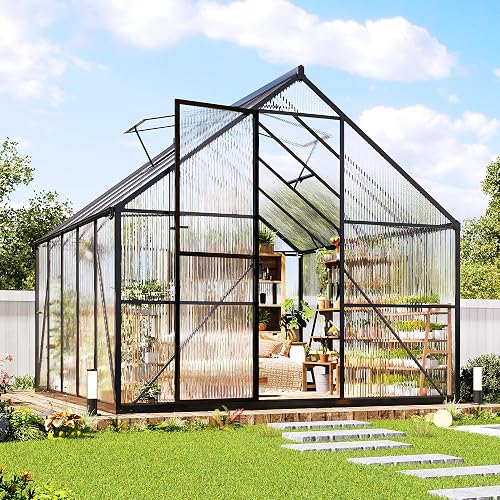 Check it
Jocisland 8x10 FT Walk-in Polycarbonate Greenhouse
Best for tool-free setup - 7
 Check it
PABIMIA 10x18 FT Aluminum Greenhouse
Best for long growing runs - 8
 Check it
Esimote 10x12 FT Greenhouse for Outdoors
Best for water collection - 9
 Check it
WKM 10x18 FT Walk-in Polycarbonate Greenhouse
Best for slide-in panel build
The best heavy duty polycarbonate greenhouse picks
Every house below uses an aluminum frame and polycarbonate panels, so the differences come down to bracing, panel style, vents and how the base is fixed. The YITAHOME 12x6FT leads for frame strength and sliding-door space saving.
The rest each solve a specific yard, climate or assembly need.
YITAHOME 12x6FT Polycarbonate Greenhouse Large Heavy Duty: Best overall
- Aluminum frame with reinforced side rods and diagonal fixing
- 4mm double-wall polycarbonate with UV protection
- Two adjustable skylights and a sliding door
A long, narrow walk-in house with extra bracing in the frame and 4mm panels that block most UV light. The sliding door saves swing space.
Pros
- Reinforced frame with diagonal rods
- Two adjustable skylights
- Sliding door saves space
Cons
- Two packages may arrive separately
- Panels benefit from glass glue at the frame joints
YITAHOME suits a gardener who wants a long growing run without a wide footprint. The 12 x 6 ft house fits along a fence or wall, and the sliding door saves the swing space a hinged door would eat.
Its frame is the strongest here on paper. Aluminum alloy uprights carry reinforced side rods and diagonal fixing, which spreads wind load across the structure rather than one wall.
The 4mm double-wall panels block most UV radiation, so plants get diffuse light instead of harsh glare. The top tilt angle on the roof helps wind run over the house and lets rain drain away.
Two adjustable skylights open to different angles, so you can tune airflow without opening the door. The sliding door saves room inside the house as well as outside it.
YITAHOME recommends setting the bottom frame in a pre-dug trench and running glass glue along the panel-to-frame joints for better water protection. It arrives in two packages that may not land on the same day.
Choose it for the best balance of frame bracing, panel thickness and usable length. Skip it if you need a square footprint, because the 6 ft depth leaves narrow aisles beside beds.
HOOYEAH 6 x 6 FT Polycarbonate Greenhouse: Best for small sheltered gardens
- Aluminum frame with a reinforcement bar
- Semi-translucent milky white panels
- Adjustable roof vent and lockable door
A compact square footprint for a corner near a fence or wall, with a lockable door and one adjustable roof vent.
Pros
- Lockable door
- Compact 6 x 6 ft footprint
- Aluminum frame with a reinforcement bar
Cons
- Only one roof vent
- Panels are milky rather than clear
HOOYEAH is the pick for a compact garden with some natural shelter. At 6 x 6 ft, it tucks into a corner near a fence, wall or shrubs, and HOOYEAH advises against fully exposed sites with strong wind.
The aluminum frame takes a reinforcement bar during assembly, which adds stiffness to a small footprint. The milky white panels are semi-translucent rather than clear, so light arrives soft and diffused.
That suits leafy crops and seedlings that scorch under direct sun. The panels still block harmful UV rays while spreading light evenly across the growing space.
One adjustable roof vent plus a lockable hinged door give you airflow and secure access. The door opens wide enough for a watering can and a wheelbarrow load of compost.
Daily watering and pruning are easy because everything is within arm's reach. HOOYEAH describes the house as waterproof and snowproof, though like any kit it needs a solid base to earn those claims.
The trade-off is space. Two people with shelving will fill a 6 x 6 ft house quickly, and a single roof vent limits how fast you can dump heat on a hot afternoon.
The milky panels also cut some light intensity, so sun-loving crops grow a little slower than under clear glazing. Pick it if your garden is small and partly sheltered.
Reljofum 6'x11' Aluminum-Framed Polycarbonate Greenhouse: Best for narrow side yards
- Aluminum frame
- Sliding door
- Two roof vents
A long, slim house that fits a strip beside a path or fence, with a sliding door and two roof vents.
Pros
- Two roof vents
- Sliding door
- Long 11 ft growing run
Cons
- Narrow width limits wide shelving
- Frame is lighter than the top pick's
Reljofum fills the gap between a compact square and a full tunnel. Its 6 x 11 ft shape runs long and narrow, so it slots into a side yard or along a path where a wider house would not fit.
The sliding door keeps the entry clear of swinging panels, and two roof vents give you more control than a single-vent kit. Aluminum framing keeps the structure light enough to move into place before you anchor it.
At 51 lb, it is one of the lighter kits here, so two people can shift it without heavy lifting gear.
Plan shelving carefully. The 6 ft width leaves room for one central aisle with beds or benches on each side, so deep pots and wide trays need measuring first.
The long 11 ft run gives you plenty of length for staging seedlings at one end and taller crops at the other.
It suits a gardener with a strip of unused ground who wants a proper walk-in house without a large footprint. Skip it if you need room for broad benches or a seating corner, because the narrow width limits what you can fit inside.
Skip it too if you want the heaviest frame in the group, since the light build trades some stiffness for easy handling.
AMERLIFE 12 x 10 x 8-Ft Hybrid: Best for quick assembly
- Hybrid clear and translucent polycarbonate panels
- Quick-connect aluminum frame
- Two adjustable roof vents and gutters
- AMERLIFE says it handles winds up to 56 mph and snow loads up to 18 psf
A wide house with a quick-connect frame and a mix of clear and translucent panels. Roof gutters channel rainwater.
Pros
- Quick-connect frame
- Gutter system collects rainwater
- AMERLIFE states a 56 mph wind rating
Cons
- Heavier unit at 245 lb
- AMERLIFE's snow load figure needs anchoring to count
AMERLIFE is the one to pick when the build has to be quick. Its quick-connect frame and hybrid panels cut install time, and AMERLIFE says three DIYers can raise it in about 6 hours.
AMERLIFE puts the time saving at roughly half the usual build and credits the connection system with a stability boost too.
The hybrid panel mix puts clear and translucent polycarbonate together. Clear sections feed light-hungry crops while translucent panels diffuse the rest, and both resist impact.
Two adjustable roof vents control airflow, and gutters collect rainwater so you can manage humidity. AMERLIFE also includes spear-shaped bird spikes to keep birds off the roof.
AMERLIFE states the frame handles winds up to 56 mph and snow loads up to 18 psf. Those figures only count once the base is anchored, so set the feet in soil or concrete.
The 12 x 10 x 8 ft house offers 435 cu ft inside, enough for beds plus a small bench. It weighs 245 lb, so plan two or three helpers for the lift.
Pick it for speed and drainage; skip it if you want the lightest possible kit or a small footprint.
CDCASA 12x10x10 FT Polycarbonate Greenhouse for Outdoors: Best for headroom
- 4mm twin-wall polycarbonate panels
- Rain gutters on both sides
- Two window vents with 5 adjustable angles
- CDCASA says it handles winds up to 56 mph and snow loads up to 20 psf
A tall walk-in house with a 10 ft peak, two angled window vents and gutters on both sides.
Pros
- Tall peak for upright growing
- Gutters on both sides
- Window vents with five angles
Cons
- Taller frame catches more wind
- Needs careful base anchoring
CDCASA suits a grower who wants to stand tall inside. The 12 x 10 x 10 ft house peaks at about 10 ft, so upright tomatoes, climbing beans and tall pots fit without bending the stems.
Two people can build it in 4 to 6 hours with the quick-connect joints.
The 4mm twin-wall panels let about 70% of light through while blocking most UV rays, and the aluminum frame takes snow loads up to 20 psf once anchored. Two window vents with five adjustable angles give you fine airflow control, and rain gutters on both sides carry water away.
You can attach a hose to the gutters and collect the runoff for watering.
CDCASA states wind resistance up to 56 mph. A 10 ft peak catches more wind than a low gable, so bury the base feet in soil or concrete, or screw the base to a board.
The snap-on door handles hold the swing doors tight when closed. It suits tall crops and anyone who wants headroom while working.
Skip it for an exposed, gusty site unless you reinforce the frame, because the height works against you in strong wind.
Jocisland 8x10 FT Walk-in Polycarbonate Greenhouse: Best for tool-free setup
- Quick connectors and triple-lock joints
- 4mm PC panels
- Two top windows and roof drainage channels
- Cross beams and corner supports with ground stakes and bolts
An 8x10 walk-in house built around tool-free connectors and triple-lock joints. Two people can put it up without tools.
Pros
- Tool-free connectors
- Cross beams and corner supports
- Two top windows
Cons
- Peak height is lower than the CDCASA
- Gable roof needs steady base levelling
Jocisland is the easiest build in this group. Quick connectors and triple-lock joints mean two people can put the 8 x 10 ft house up without tools, and Jocisland puts the time at 2 to 3 hours.
That speed comes without giving up the frame details, since the connectors lock panels and frame together as they join.
The reinforced structure uses cross beams, top braces and corner supports, plus ground stakes and bolts to hold the base. A gable roof sheds water instead of pooling it, and two top windows improve airflow.
Built-in roof channels drain rainwater. The 4mm PC panels block nearly all UV rays and hold warmth for year-round planting.
The peak height is about 6.7 ft, lower than the CDCASA, so taller gardeners should check headroom before buying. The base footprint needs careful levelling for the gable roof to sit square.
Pick it if you want a tool-free weekend build and a house that handles rain well. Skip it if you need generous height or a long tunnel footprint.
PABIMIA 10x18 FT Aluminum Greenhouse: Best for long growing runs
- Powder-coated aluminum frame
- 4mm double-wall polycarbonate panels
- Adjustable roof vent
- Integrated drainage gutters
A long tunnel-style house that gives you a straight run of beds. The powder-coated frame and 4mm panels keep weight down.
Pros
- Long 18 ft run
- Powder-coated frame
- Integrated gutters
Cons
- Large footprint needs a big yard
- Only two vents for an 18 ft interior
PABIMIA suits a large plot where you want one long, straight run of beds. At 10 x 18 ft, the house gives you an 18 ft growing length with a 98 in peak, so you can work standing up.
The powder-coated aluminum frame resists rust, and 4mm double-wall panels balance light transmission with diffusion. Two adjustable roof vents and integrated gutters help you manage heat and rainwater.
Slide-in panels simplify the build and add support to the structure. PABIMIA lists the peak height as 98 in and describes 6 ft 8 in of standing room under the ridge.
The footprint is the catch. A 10 x 18 ft house needs a big, level patch of ground, and two roof vents may still be modest for that volume of air on a hot day.
Plan extra venting or shade cloth for summer. Like most long tunnels here, the roof runs the full 18 ft and catches wind along its whole length.
Pick it for a serious growing run in a large garden. Skip it for a small yard or an exposed, windy site.
Esimote 10x12 FT Greenhouse for Outdoors: Best for water collection
- Adjustable roof vent with five levels
- Built-in drainage channels
- Sliding door
- Lockable metal handle
A 10x12 house with drainage channels you can pipe to a water butt. The five-level roof vent controls airflow.
Pros
- Drainage channels can connect to pipes
- Five vent positions
- Lockable sliding door
Cons
- One roof vent only
- Frame needs ground anchoring
Esimote is the pick for gardeners who want to collect rainwater. Built-in drainage channels can connect to pipes, so roof runoff goes to a butt or barrel rather than puddling at the base.
That makes it the house to choose if you water from stored rain.
The 10 x 12 ft house has a sliding door with a lockable metal handle and an adjustable roof vent with five levels. The reinforced aluminum frame and polycarbonate panels handle normal wind, rain and snow once the footing is set in soil or concrete.
The sliding door takes up less room than a swing door, so the interior stays clear.
Its 98 in peak matches the PABIMIA and WKM, so headroom is generous. The door measures 23.2 in wide by 78.3 in tall, so measure anything you plan to wheel inside.
The roof vent measures about 23.5 in square. The trade-off is a single roof vent on a house this size, which limits how quickly you can cool it in summer.
Pick it if water management matters more than vent count. Skip it if you want multiple vents for fine airflow control across a large interior.
WKM 10x18 FT Walk-in Polycarbonate Greenhouse: Best for slide-in panel build
- Slide-in panel assembly
- Adjustable roof vent with five settings
- Lockable door and metal handle
- WKM says panels are 720 g/m2 polycarbonate
A large walk-in house that uses slide-in panels to speed the build. The base cover and five vent settings help control airflow.
Pros
- Slide-in panels speed assembly
- Five vent settings
- Base safety cover
Cons
- Lowest score in this group
- Large footprint and long build time
WKM rounds out the group with a 10 x 18 ft walk-in house built around slide-in panels. WKM says the panel system speeds assembly and improves the seal, and the base safety cover adds protection at ground level.
The plug-in panel design is meant to hold a tight seal while keeping the build simple.
The five-setting roof vent gives more airflow control than most houses here, and the lockable door with a metal handle keeps the interior secure. The powder-coated aluminum frame and 4mm panels handle normal seasonal weather.
WKM's panels are stated at 720 g/m2, which is on the heavier side for polycarbonate.
WKM also says the frame height can be adjusted to suit the plants you grow. The trade-off is the build: a house this large takes time even with slide-in panels, and the long footprint needs a level, open site.
Pick it if you want the largest footprint here and fine vent control. Skip it if you are working alone or have a modest yard, because the size and weight make the build a two-person job.
How these greenhouses compare
The comparison table lines up frame, panel, vent and anchoring details so you can match a house to your yard. Scores weigh specs and features against what a heavy duty buyer is shopping for.
A long footprint suits market-style growing, while a compact square fits a sheltered corner. The table also shows which houses add gutters, since rainwater management is a real divider between kits at this level.
| Product | Best for | Size | Frame | Panels | Our score |
|---|---|---|---|---|---|
| YITAHOME 12x6FT Polycarbonate Greenhouse Large Heavy Duty | overall | 12 x 6 ft | Aluminum | 4mm double-wall polycarbonate | 9.5 |
| HOOYEAH 6 x 6 FT Polycarbonate Greenhouse | small sheltered gardens | 6 x 6 ft | Aluminum | 9.3 | |
| Reljofum 6'x11' Aluminum-Framed Polycarbonate Greenhouse | narrow side yards | 6 x 11 ft | Aluminum | 9.2 | |
| AMERLIFE 12 x 10 x 8-Ft Hybrid | quick assembly | 12 x 10 x 8 ft | Aluminum | 8.8 | |
| CDCASA 12x10x10 FT Polycarbonate Greenhouse for Outdoors | headroom | 12 x 10 x 10 ft | Aluminum | 8.5 | |
| Jocisland 8x10 FT Walk-in Polycarbonate Greenhouse | tool-free setup | 8 x 10 ft | Aluminum | 8.3 | |
| PABIMIA 10x18 FT Aluminum Greenhouse | long growing runs | 10 x 18 ft | Aluminum | 8.2 | |
| Esimote 10x12 FT Greenhouse for Outdoors | water collection | 10 x 12 ft | Aluminum | 8.0 | |
| WKM 10x18 FT Walk-in Polycarbonate Greenhouse | slide-in panel build | 10 x 18 ft | Aluminum | 7.8 |
How we compared these heavy duty greenhouses
We started with the frame. Every kit here uses aluminum, so we looked for extra bracing, like the diagonal rods on the YITAHOME and the cross beams on the Jocisland.
A frame with corner supports and base fixings scored higher than one that relies on uprights alone.
Panel thickness came next. All nine use 4mm polycarbonate, so the differences are in panel style: double-wall, twin-wall and hybrid mixes each change light and heat inside.
The YITAHOME and CDCASA list UV blocking figures, and the WKM lists a panel weight, which helps compare how much material sits in the wall.
We then weighed ventilation and anchoring. Roof and window vents decide how well you can cool a house in summer, and the base design decides whether it stays put in wind.
Two adjustable vents, like on the YITAHOME and Reljofum, scored better than a single vent, and five-angle window vents scored best of all. Price tier and footprint size were the final filters.
Our score weighs specs, features and how well each house fits what a heavy duty buyer needs. For panel detail, read our guide on what thickness polycarbonate for a greenhouse is right for your climate.
What should you look for in a heavy duty polycarbonate greenhouse?
Start with the frame and base, because those two decide whether the house survives its first winter. Panels and vents matter next.
A thick panel on a light frame still fails in a storm, and a well-braced frame with thin panels loses heat.
Frame bracing and base anchoring
Look for reinforced rods, diagonal fixing or cross beams rather than plain uprights. The YITAHOME adds reinforced side rods and diagonal fixing, while the Jocisland uses cross beams and corner supports.
The AMERLIFE relies on a quick-connect system that locks the frame together as it goes up.
The base is just as important. Most kits here recommend burying the feet in soil or concrete, or screwing the base to a wooden frame.
The CDCASA suggests a pressure-treated wooden frame of the same size as the house. A house that is not anchored will shift in the first strong gust, whatever its wind rating says.
Run glass glue or silicone along the panel joints as YITAHOME and CDCASA advise, since that seal is what keeps rain out.
Panel thickness and light style
All the houses here use 4mm polycarbonate. Twin-wall and double-wall panels trap air between layers and hold warmth better than a single sheet.
Clear panels feed light-hungry crops, while milky or hybrid panels diffuse light and reduce glare. The AMERLIFE hybrid puts both on one roof.
If your site is cold or exposed, 6mm panels are the sensible upgrade. For a sunny, mild garden, 4mm twin-wall does the job.
Our comparison of polycarbonate greenhouse vs glass explains how the panels handle heat and impact differently from glazing.
Ventilation for summer heat
Vents are what stop a polycarbonate house from cooking plants in July. Two adjustable roof vents, as on the YITAHOME and Reljofum, beat a single fixed vent.
The CDCASA's five-angle window vents give the finest control here. The Esimote and WKM both use five-level vent settings.
Plan shade cloth or a second vent for any house with one roof vent over a large volume. On a 10 x 18 ft tunnel, one vent is a modest opening for the air inside.
Close doors and vents during strong wind, as the CDCASA and YITAHOME instructions note.
Footprint and site exposure
Match the footprint to your ground before anything else. A 12 x 6 ft house runs long and narrow, a 6 x 6 ft house fits a corner, and a 10 x 18 ft tunnel needs a large, level run.
The Jocisland lists a base size larger than its nominal 8 x 10 ft, so leave margin for the frame feet.
Wind exposure matters as much as size. HOOYEAH advises a site with partial shelter near fences or shrubs.
A tall 10 ft peak catches more wind, so leave a clear margin around the house for airflow and maintenance. Our comparison of polycarbonate greenhouse vs plastic helps if you are still deciding on the cover material.
Doors and access
Door style changes how much room the house really gives you. The YITAHOME and Reljofum use sliding doors that save swing space, which matters in a narrow 6 ft house.
The HOOYEAH, CDCASA, Jocisland and AMERLIFE use hinged or swing doors, and the CDCASA pairs its swing doors with snap-on handles that hold them tight.
Check the door opening size before you buy. The Esimote lists a 23.2 in wide by 78.3 in tall opening, so wide barrows and big pots need measuring first.
A lockable door, as on the HOOYEAH, Esimote and WKM, adds security for tools as well as plants.
Which heavy duty polycarbonate greenhouse is best for your yard?
The YITAHOME 12x6FT is the best all-round choice for most yards, and the rest are best for a named need. Use this decision rule to narrow it down.
Pick the YITAHOME for the strongest braced frame and a long, narrow footprint. Pick the AMERLIFE if you want a quick build with gutters and a 56 mph wind rating.
Pick the CDCASA if you need 10 ft of headroom for tall crops. Pick the Jocisland if a tool-free build matters most.
Pick the HOOYEAH for a small, sheltered garden corner.
For a large plot, the PABIMIA and WKM both offer an 18 ft run, with WKM adding five vent settings and PABIMIA a lower-weight build. The Esimote suits water collection, and the Reljofum fits a narrow side yard.
Whatever you choose, anchor the base and clear the roof after snow. A heavy duty polycarbonate greenhouse is only as strong as the ground it sits on, so set the base before the panels go up.
That order matters more than any single spec on the box.
Our top 3 picks at a glance
-
1
Best overall
YITAHOME 12x6FT Polycarbonate Greenhouse Large Heavy Duty
9.5/10 our score
See it on Amazon -
2
Best for small sheltered gardens
HOOYEAH 6 x 6 FT Polycarbonate Greenhouse
9.3/10 our score
See it on Amazon -
3
Best for narrow side yards
Reljofum 6'x11' Aluminum-Framed Polycarbonate Greenhouse
9.2/10 our score
See it on Amazon
Frequently asked questions
Is 4mm polycarbonate thick enough for a greenhouse?
4mm twin-wall polycarbonate is the common standard for backyard kits and handles normal seasonal weather when the frame is braced and anchored. Thicker 6mm or 8mm panels hold more heat and resist impact better, but they add weight and cost.
For exposed, windy sites, 6mm is the safer upgrade.
Can a heavy duty polycarbonate greenhouse stay up in winter?
Yes, if the frame is rated for snow load and you clear heavy buildup. Several houses here state snow load figures around 18 to 20 psf.
Keep the roof clear after storms, close doors and vents in high wind, and anchor the base into soil or concrete.
Do I need to anchor a polycarbonate greenhouse?
Yes. Even a braced aluminum frame can lift or shift in strong gusts.
Bury the base feet in soil or set them in concrete, or use expansion screws into a wooden base.
Kits often include stakes or bolts, but a solid base frame is what keeps the house square.
What is the difference between clear and translucent polycarbonate panels?
Clear panels let more direct light through and suit light-hungry crops. Translucent or milky panels scatter light and reduce glare, which can help seedlings and tender leaves.
Hybrid kits mix both to balance light transmission and diffusion across the roof and walls.
How much space do I need for a walk-in polycarbonate greenhouse?
Plan the footprint plus a clear margin on all sides for airflow and maintenance. A 6x6 ft house needs a compact corner, while a 10x18 ft tunnel needs a long open run.
Leave room to open doors and reach the roof vents without leaning over beds.


