8 Best Greenhouse Heaters (November 2026)
The best greenhouse heaters include the VEVOR 1500W Greenhouse Heater with Thermostat for sheltered seedling spaces, the ZIZIWIN 1500W Greenhouse Heater with Thermostat for first greenhouse setups, and the TRUSTECH 1500W Greenhouse Heater with Digital Thermostat for changing seasonal needs.
On this page (9 sections)
- How we chose the best greenhouse heaters
- Which greenhouse heater fits your growing setup?
- How much heat does your greenhouse actually need?
- Which controls matter for frost protection and seedlings?
- How should you set up an electric greenhouse heater?
- How do you manage moisture without losing all the warmth?
- What care keeps a greenhouse heater working properly?
- Which greenhouse heating mistakes should you avoid?
- Which of the best greenhouse heaters should you choose?
The VEVOR 1500W Greenhouse Heater with Thermostat is our top pick among the best greenhouse heaters for a small, sheltered growing space with dry placement. Choose TRUSTECH for changing heat needs or Tonree when water-resistant housing is a priority.
The right heater depends on what you're protecting: dormant plants that need frost protection or active seedlings that need steadier warmth. Set that goal before comparing controls or coverage claims.
Start with our guide on how to heat a greenhouse for the wider heating plan. If warmth escapes through gaps or a thin cover, how to keep a greenhouse warm explains where to focus first.
Our picks at a glance
-
1
 Best for sheltered seedling spaces
VEVOR 1500W Greenhouse Heater with Thermostat
8.4/10 our score
See it on Amazon -
2
 Best for first greenhouse setups
ZIZIWIN 1500W Greenhouse Heater with Thermostat
8.2/10 our score
See it on Amazon -
3
 Best for changing seasonal needs
TRUSTECH 1500W Greenhouse Heater with Digital Thermostat
7.6/10 our score
See it on Amazon
- 4
 Check it
Tonree 1500W Greenhouse Heater with Digital Thermostat
Best for damp growing spaces - 5
 Check it
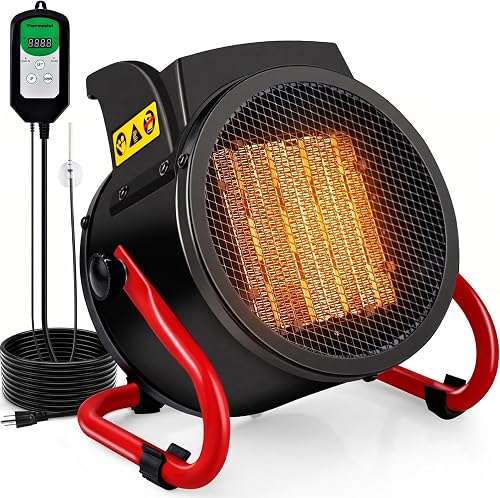
SmterCon 1500W Greenhouse Heater, Auto Power Control
Best for adjustable bench airflow - 6
 Check it
VEVOR 1500W Greenhouse Heater with Fan
Best for supervised greenhouse work - 7
 Check it
Roodike 1500W Blower Heater with Thermostat
Best for sheltered overwintering areas - 8
 Check it
VEVOR 1500W Electric PTC Space Heater
Best for frequent repositioning
How we chose the best greenhouse heaters
We compared temperature control, usable heat settings, airflow and placement needs for small growing spaces. A heater earns a place here by fitting a clear buyer need, rather than by promising the largest coverage area.
All 8 picks reach the same maximum electrical input, so their main differences are controls and practical use. A digital display, lower heat mode or water-resistant housing may matter more to your setup than a broad coverage claim.
We gave preference to included thermostat control while keeping moisture limits and unclear settings in view. No score means a heater can overcome an unsealed structure or maintain any chosen temperature through severe cold.
| Product | Best for | Power | Controls | Modes | Our score |
|---|---|---|---|---|---|
| VEVOR 1500W Greenhouse Heater with Thermostat | sheltered seedling spaces | 1500W | Independent thermostat and 3 speed settings | Heating and ventilation | 8.4 |
| ZIZIWIN 1500W Greenhouse Heater with Thermostat | first greenhouse setups | 1500W | Independent digital thermostat | Heating and adjustable ventilation | 8.2 |
| TRUSTECH 1500W Greenhouse Heater with Digital Thermostat | changing seasonal needs | 750W or 1500W | Digital thermostat, 40°F to 108°F | Low heat, high heat and fan only | 7.6 |
| Tonree 1500W Greenhouse Heater with Digital Thermostat | damp growing spaces | 20W, 750W or 1500W | Independent digital thermostat | Fan only, moderate warmth and full heat | 7.4 |
| SmterCon 1500W Greenhouse Heater, Auto Power Control | adjustable bench airflow | 1500W | Digital thermostat | Heating and adjustable ventilation | 7.2 |
| VEVOR 1500W Greenhouse Heater with Fan | supervised greenhouse work | 1500W | Two temperature settings | Heating and fan | 7.0 |
| Roodike 1500W Blower Heater with Thermostat | sheltered overwintering areas | 750W or 1500W | Adjustable thermostat, 32°F to 158°F | High heat, low heat and natural wind | 6.9 |
| VEVOR 1500W Electric PTC Space Heater | frequent repositioning | 1500W | Low and high heat modes | Heating and fan | 6.5 |
Which greenhouse heater fits your growing setup?
Choose a thermostat-equipped model for temperature management and a simpler portable model when you mainly need supervised warmth. The write-ups below explain the tradeoffs that matter beyond the comparison table.
VEVOR 1500W Greenhouse Heater with Thermostat: Best for sheltered seedling spaces
- Independent thermostat
- 3 speed settings
- Heating and ventilation modes
- Overheat protection
A compact choice for sheltered growing spaces where you want a separate thermostat and adjustable airflow. Its IP20 protection requires dry placement.
Pros
- Independent thermostat
- 3 speed settings
- Fan-only ventilation mode
Cons
- No water protection from IP20
- Rear vents need careful clearance
This VEVOR suits a sheltered seedling area where you want separate temperature control and adjustable air movement. Its independent thermostat, 3 speed settings and fan-only mode give you several ways to manage conditions without changing equipment.
VEVOR describes the thermostat as monitoring soil temperature. That's useful when root-zone warmth is your concern, but place the sensor as directed and check air temperature separately if leaves also need protection.
The compact body measures 6.29 x 6.29 x 8.66 inches and weighs 4.5 lb. Leave space beyond that footprint for airflow, safe clearances and access to the controls.
Its IP20 protection does not provide water resistance, so skip this model if you cannot give it a dry location. VEVOR recommends an airflow angle around 25° and warns that steeper angles can obstruct the rear vents.
Buy it for controlled warmth in a protected growing area. Choose Tonree instead when water-resistant housing is central to your plan.
ZIZIWIN 1500W Greenhouse Heater with Thermostat: Best for first greenhouse setups
- Digital thermostat included
- Automatic temperature control
- Adjustable ventilation
- Overheat protection
The heater and digital thermostat come together, making this a practical starting point for automatic temperature control. Choose another model if you need a confirmed lower-watt heat mode.
Pros
- Digital thermostat included
- Automatic on/off control
- Adjustable ventilation
Cons
- No confirmed 750W mode
- Claimed coverage depends on greenhouse conditions
ZIZIWIN is a practical first heater kit for buyers who want the heater and digital thermostat together. The separate controller switches the heater on and off around your chosen temperature, avoiding repeated manual adjustments as the air cools.
Adjustable ventilation also gives you a way to move air when heating isn't needed. That helps circulation around pots, though exchanging damp indoor air still requires greenhouse ventilation.
ZIZIWIN claims heating coverage up to 120 sq ft. Use that as an initial screen, then consider ceiling height, cover material and the temperature gap you're asking the heater to maintain.
Choose this kit if automatic cycling matters more than selecting a specific lower-watt setting. Its adjustable temperature and wind controls should not be confused with a confirmed 750W heat mode.
Skip it if reduced output is a firm requirement for your electrical plan or mild-weather use. TRUSTECH and Tonree offer clearly defined lower heat settings.
TRUSTECH 1500W Greenhouse Heater with Digital Thermostat: Best for changing seasonal needs
- 750W and 1500W heat modes
- Fan-only mode
- Digital thermostat
- 90° adjustable tilt
Two heat levels and a digital thermostat suit growing spaces that need different output across the season. The waterproof sensor probe does not make the whole heater waterproof.
Pros
- Two heat levels plus fan-only mode
- Defined thermostat range
- Adjustable tilt
Cons
- Lowest thermostat setting is 40°F
- Indoor usage specification
TRUSTECH is the clearest choice for buyers who expect heating needs to change across the season. It combines 750W and 1500W heat settings with fan-only operation, so you can select output separately from the target temperature.
Its digital thermostat spans 40°F to 108°F. The lower limit matters if you only want near-freezing frost protection: this control starts warmer than that goal.
A 90° tilting head helps direct airflow around a bench layout, while the 7.5 ft cord gives some placement flexibility. Neither feature removes the need for the manual's clearances or a suitable nearby outlet.
TRUSTECH describes the sensor probe as waterproof, but that protection should not be extended to the heater or controller. Its usage specification is indoor, so confirm that your sheltered greenhouse installation is permitted.
Choose it for distinct output choices and a defined control range. Skip it if you need a thermostat setting below its minimum or cannot provide protected placement.
Tonree 1500W Greenhouse Heater with Digital Thermostat: Best for damp growing spaces
- Digital thermostat
- 20W fan-only mode
- 750W and 1500W heat modes
- IPX5 water resistance
Tonree combines water-resistant heater housing with two heat levels and automatic thermostat control. Keep the thermostat and electrical connections protected according to their own instructions.
Pros
- Three power modes
- Digital thermostat with automatic cycling
- Tonree specifies IPX5 water resistance
Cons
- Confirm thermostat range for frost protection
- Heater protection does not cover every connection
Tonree is worth choosing when damp conditions make water-resistant heater housing a priority. Tonree specifies IPX5 water resistance, which sets it apart from the top VEVOR's dry-placement needs.
The separate digital thermostat handles automatic cycling, while 750W and 1500W heat modes let you choose output. Its 20W fan-only setting provides circulation without running the heating element.
Keep the scope of that protection clear: the heater's water resistance does not guarantee the thermostat's or connections' suitability for spray. Arrange the entire setup around watering routes, dripping panels and the instructions for each component.
Tonree also includes dual overheat shut-off and a carrying handle. Those features suit a small growing area where placement may change as benches fill, provided the new position still meets all clearances.
Choose it for the combination of moisture protection and output choices. If you need a particular low-temperature setpoint, confirm the thermostat's range before deciding.
SmterCon 1500W Greenhouse Heater, Auto Power Control: Best for adjustable bench airflow
- Digital thermostat included
- Automatic power control
- Adjustable tilt head
- Adjustable ventilation
An adjustable tilt head helps direct airflow around a growing area, while the separate thermostat controls heating cycles. It suits buyers who value positioning more than a confirmed low-watt mode.
Pros
- Digital thermostat included
- Adjustable tilt head
- Ventilation function
Cons
- No confirmed 750W mode
- Claimed coverage depends on heat loss
SmterCon fits buyers whose main challenge is directing warmth around a plant bench. Its adjustable tilt head lets you change the airflow direction while the included digital thermostat manages power cycling.
Aim moving air through an open route around the plants, rather than straight at one tray. A direct warm stream can leave nearby pots drying faster while plants behind solid shelving remain cold.
This model also has adjustable ventilation for times when you want circulation without added warmth. Its main appeal is that positioning flexibility paired with automatic control.
SmterCon claims coverage up to 120 sq ft, but a bench, partition or dense group of pots can interrupt air movement within a space that size. Check the far side of the growing area with a separate thermometer.
Choose SmterCon when its adjustable head solves a real layout problem. Skip it if a confirmed lower-watt heating mode matters more, since TRUSTECH and Tonree make that choice clearer.
VEVOR 1500W Greenhouse Heater with Fan: Best for supervised greenhouse work
- Fan and heating modes
- Two temperature settings
- 25° adjustable angle
- Overheat shutoff
A portable option for warmth while you work in a sheltered greenhouse. Its directional airflow is useful when you can monitor conditions and adjust placement.
Pros
- Fan and heating modes
- 25° adjustable angle
- Portable handle and stable base
Cons
- Indoor use
- No included independent thermostat identified
This orange VEVOR is a better match for supervised greenhouse work than for buyers seeking an included digital thermostat kit. Fan and heating modes, two temperature settings and a 25° adjustable angle cover straightforward warmth and air movement.
Use it when you're potting, checking plants or working in a sheltered growing space and can watch conditions. Keep a thermometer near the plants rather than judging their warmth from how comfortable you feel beside the outlet.
The handle and stable base help with moving it, though its 6.4 lb weight makes it the heavier VEVOR option here. Choose a permanent clear position if carrying it around would encourage awkward cord routing.
The indoor usage specification still matters, even though the title mentions IPX4 protection. Water resistance does not turn an indoor heater into equipment for an exposed location.
Skip this model if precise automatic temperature management is your first requirement. A kit with an independent thermostat is the more direct choice for that job.
Roodike 1500W Blower Heater with Thermostat: Best for sheltered overwintering areas
- 1500W and 750W heat modes
- Natural wind setting
- Adjustable thermostat
- Overheat protection
A compact blower for a modest, sheltered plant area where adjustable heat output matters. Roodike warns that its winter heating capacity is limited.
Pros
- Three operating modes
- Thermostat range starts at 32°F
- Compact and portable
Cons
- Limited heat in cold conditions
- Indoor use
Roodike suits a modest, sheltered overwintering area where you want two heat levels and thermostat control. Its blower design moves warm air, with 750W, 1500W and natural-wind modes for different conditions.
The thermostat range starts at 32°F and extends to 158°F. The upper setting is not a useful target for greenhouse plants, and the lower endpoint leaves little room for sensor error when frost protection is the goal.
Roodike warns that this compact heater provides limited winter heat and recommends spaces up to 120 sq ft. Take that warning seriously if your greenhouse has a loose cover or faces long, hard freezes.
Its overheat protection and power reduction during poor heat dissipation are reasons to keep airflow clear, not reasons to accept a blocked intake. Fallen leaves and stored bags should stay well away.
Choose it for supplemental warmth in a protected area. Skip it as your sole plan for a large or leaky winter greenhouse.
VEVOR 1500W Electric PTC Space Heater: Best for frequent repositioning
- Low and high heat modes
- Fan mode
- Overheat protection
- Tip-over shut-off
The lightweight body suits buyers who move a heater between permitted sheltered locations. Basic heat and fan settings come with overheat protection and tip-over shut-off.
Pros
- Weighs 3.1 lb
- Low and high heat modes
- Tip-over shut-off
Cons
- Indoor use
- No included independent thermostat identified
This VEVOR is the choice for buyers who expect to move the heater often between permitted sheltered locations. At 3.1 lb, it's the lightest VEVOR in this roundup, with a handle for repositioning.
Low and high heat modes plus a fan setting cover basic use. Overheat protection and tip-over shut-off add protective functions, but the heater still needs a stable, level position away from traffic.
Move it only after switching it off, unplugging it and allowing it to cool as directed. Check the new location for water exposure and cord hazards instead of assuming any empty patch of floor will work.
Choose this model when portability and simple controls are the main requirements. It makes less sense if you want an included independent thermostat to manage a specific temperature.
Skip it for exposed use or any location where watering can reach the unit. For a fixed plant-care setup with automatic cycling, start with the thermostat kits above.
How much heat does your greenhouse actually need?
Choose capacity from heat loss and your target temperature, not floor area alone. A tall greenhouse with a loose cover can need more heat than a shorter, tightly closed structure with the same footprint.
Start by measuring length, width and height, then note the cover material and obvious gaps. Our greenhouse size guide helps you think through the space you're heating, including room above and around the benches.
Match the best greenhouse heaters to a plant temperature goal
Set the lowest acceptable temperature for the plants you intend to keep. Dormant plants, tender foliage and seed trays can have different needs, so a single warm-room target may waste energy or still miss the most vulnerable crop.
Next, compare that target with your coldest expected outdoor conditions. Holding a modest temperature gap on a mild night is a different job from keeping tender plants warm through a hard freeze.
A coverage claim cannot account for every version of that job. Use manufacturer guidance alongside a greenhouse heat-loss calculation when deciding whether this class of portable heater is enough.
Fix the enclosure before adding more heaters
Close unintended gaps around doors and damaged panels before expecting better heating. Keep designed ventilation available so you can manage moisture and daytime heat.
For a structure that needs major winter changes, our winter greenhouse guide covers the enclosure choices. Adding heaters to compensate for a loose cover can create a larger electrical demand without solving cold drafts at plant level.
Which controls matter for frost protection and seedlings?
Prioritize a suitable thermostat range and correct sensor placement over a bright display. A thermostat can only react to conditions where it measures them.
For air-temperature control, place the sensor near the plants you need to protect, following its instructions. Avoid the heater's direct stream, sun-warmed panels and a door draft unless that location is specifically what you need to monitor.
Soil sensing answers a different question from air sensing. A warm pot does not prove the leaves are protected, and warm air does not prove a cold tray has reached a useful germination temperature.
Use an independent minimum-and-maximum thermometer to check overnight lows. Compare readings near the coldest pots and in the main growing area before trusting one setpoint across the whole structure.
A lower heat setting controls output, while a thermostat controls when heat runs. Lower output can suit mild conditions, but it may run longer; choosing it does not automatically reduce total energy use for the same temperature goal.
How should you set up an electric greenhouse heater?
Set the heater on a stable, permitted surface with clear airflow and a suitable power supply. Complete the placement and electrical checks before arranging plants around it.
Read the manual for clearances on every side, including above the unit. Keep plastic covers, fleece, seed trays, dry leaves and stored compost bags outside those clearances.
Plan the airflow route through open space around the benches. Don't aim concentrated heat at foliage or let a solid shelf block the path to the rest of the greenhouse.
For the electrical setup:
- Use the power connection required by the heater's instructions.
- Avoid power strips and adapters that are unsuitable for heater loads.
- Use GFCI protection where required for the location.
- Keep plugs, controllers and sockets away from water and wet ground.
- Have an electrician check the supply if its suitability is unclear.
At 120 volts, a 1500W heater draws about 12.5 amps while heating at full output. A thermostat controller's 15A capacity does not mean you can add other loads freely to the same circuit.
Don't assume an extension cord is acceptable; many portable heater instructions prohibit one. If the outlet is too far away, solve the power location rather than routing a questionable lead through the greenhouse.
Water the plants with the electrical layout in mind. A heater can sit clear of irrigation spray yet still be below a dripping seam or beside a wet hose connection.
How do you manage moisture without losing all the warmth?
Use air circulation for even conditions and ventilation for air exchange. A heater's fan moves existing air, but it doesn't carry moisture outside a closed greenhouse.
Heating can lower relative humidity while it runs without removing water from the space. Condensation may return as surfaces cool, especially after watering.
Water early enough for excess moisture to clear when conditions allow, and avoid leaving standing water around pots. Keep drainage routes open and inspect the cover for drips above electrical equipment.
Use planned ventilation rather than sealing every opening permanently. Our guide to greenhouse ventilation, vents and fans explains how to arrange air exchange alongside circulation.
Sunny winter days can also warm a greenhouse quickly. Don't leave a winter heat setting in charge of the whole day without checking how vents and doors handle rising temperatures.
What care keeps a greenhouse heater working properly?
Keep intakes, outlets and the surrounding floor clear so the heater can move air as intended. Check more often during potting work, when loose compost and plant debris are easy to scatter.
Before cleaning, switch the unit off, unplug it and let it cool. Follow the manual's cleaning method rather than spraying the housing or pushing debris inside.
Inspect the cord and plug for damage, discoloration or unusual heat during normal checks. Stop using the equipment if anything appears wrong, and don't keep resetting a protective shutoff without finding the cause.
Check the thermostat sensor after moving trays or rearranging benches. A probe left in sun or knocked beside the outlet can change heating cycles even when the selected temperature hasn't changed.
At season's end, clean and dry the equipment as directed before storage. Keep the controller, probe and instructions together so the next setup starts with the right parts.
Which greenhouse heating mistakes should you avoid?
Avoid choosing by floor area alone, sensing the wrong location and ignoring power limits. Those mistakes can leave plants cold even while the heater seems to be working.
Don't set the thermostat much higher to make a cold greenhouse warm faster. The setting is a target, and raising it can cause overshoot once the space catches up.
Don't place plants against the warm-air outlet to protect them first. That can dry one tray while blocking heat from reaching the rest of the growing area.
Don't add a second heater without checking the electrical supply. Separate sockets may share a circuit, so another outlet does not automatically mean another heater load is available.
Plan for a power cut or an unusually cold night before either happens. Identify which tender plants you can move indoors and where they will go if the greenhouse cannot hold their minimum temperature.
Which of the best greenhouse heaters should you choose?
Choose the VEVOR thermostat model for a sheltered seedling space with dry placement. Choose ZIZIWIN for a straightforward first thermostat kit, TRUSTECH for changing output needs, or Tonree when water-resistant housing is a key requirement.
SmterCon makes sense when directing airflow around benches is the main concern. The simpler VEVOR models suit supervised warmth or frequent moves, while Roodike fits modest supplemental heating in a protected overwintering area.
Before ordering any of the best greenhouse heaters, confirm your plant temperature goal, permitted placement and electrical supply. Then use our guide on how to keep a greenhouse warm to reduce the heat your chosen unit needs to replace.
Our top 3 picks at a glance
-
1
Best for sheltered seedling spaces
VEVOR 1500W Greenhouse Heater with Thermostat
8.4/10 our score
See it on Amazon -
2
Best for first greenhouse setups
ZIZIWIN 1500W Greenhouse Heater with Thermostat
8.2/10 our score
See it on Amazon -
3
Best for changing seasonal needs
TRUSTECH 1500W Greenhouse Heater with Digital Thermostat
7.6/10 our score
See it on Amazon
Frequently asked questions
How many watts should a greenhouse heater have?
Size the heater for heat loss, not floor area alone; greenhouse height, cover, drafts and the gap between outdoor and target temperatures all matter. These picks offer up to 1500W, but a tall or leaky structure may need a different heating plan even when its floor area seems small.
Is a thermostat useful in a greenhouse heater?
Yes, a thermostat switches heat on and off around a chosen temperature, which reduces manual adjustment; match its range and sensor placement to your plants. Use a separate thermometer near the coldest pots, since a warm reading beside the heater can hide a cold corner across the greenhouse.
Can a greenhouse heater also move air?
Yes, several models here have a fan-only or ventilation mode for moving air without adding heat; that helps circulation but does not remove moisture from a closed greenhouse or cool it below the surrounding air temperature. Use vents or other ventilation when you need to exchange indoor and outdoor air.
Can I leave a greenhouse heater running overnight?
Only use a heater overnight if its instructions permit your intended operation and you can meet all placement, electrical and supervision requirements; automatic cycling and overheat protection do not replace those rules. Plan a backup location for vulnerable plants if power fails or the heater cannot hold the needed temperature.
Does a greenhouse heater need to be waterproof?
The heater must suit the moisture exposure in its exact location; a damp greenhouse, irrigation spray and direct rain create different conditions. Water resistance on the heater does not automatically cover its thermostat, plug or socket, so protect each part and follow the instructions for the complete setup.